
Sample and treatment hypothesis
Review tumor type, sample state, prior treatment and the immune process the candidate is intended to change.
Application
Use PDO 2.0 / ALI and project-relevant immune assays to study relationships among immune composition, architecture and treatment response.
PDO 2.0 immune studies
PDO 2.0 studies in ccRCC and NSCLC combine tissue profiling, ICB-related flow readouts and CD4/CD8 measurements under IL-2 conditions to inform sample selection, treatment design and immune endpoints.
 View image
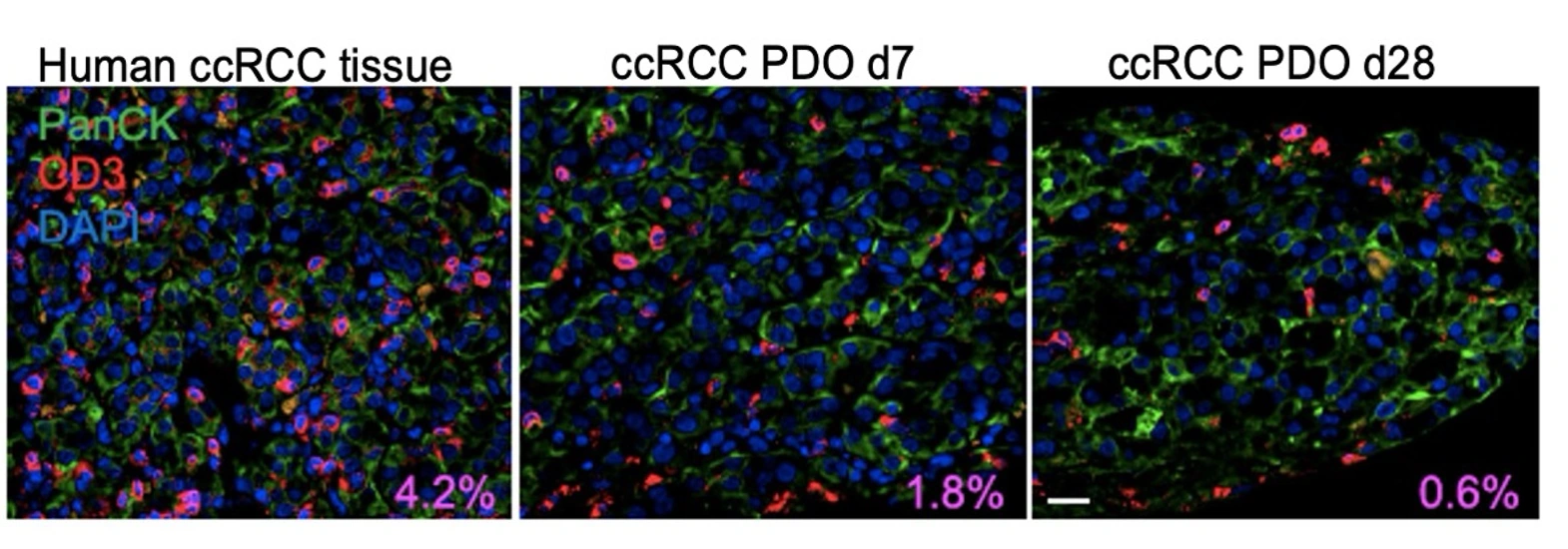
Tissue and model context: PanCK, CD3 and DAPI imaging compares tumor-epithelial and CD3-positive immune-cell signals across the source tissue and PDO culture time points.
TRiCBIO ccRCC PDO 2.0 immune-context study data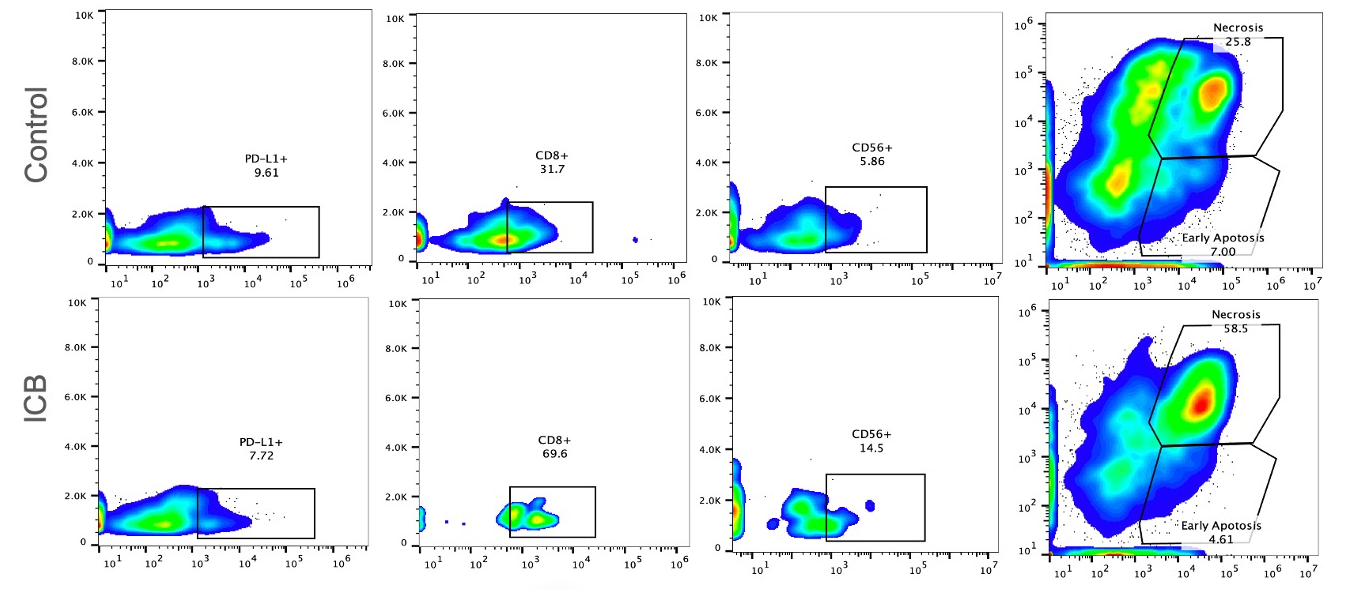 View image
Treatment-related readouts: PD-L1-, CD8- and CD56-associated flow profiles are interpreted alongside early-apoptosis and necrosis measurements to compare immune-associated and cell-death changes under immune-checkpoint blockade.
TRiCBIO ccRCC PDO 2.0 immune-context study data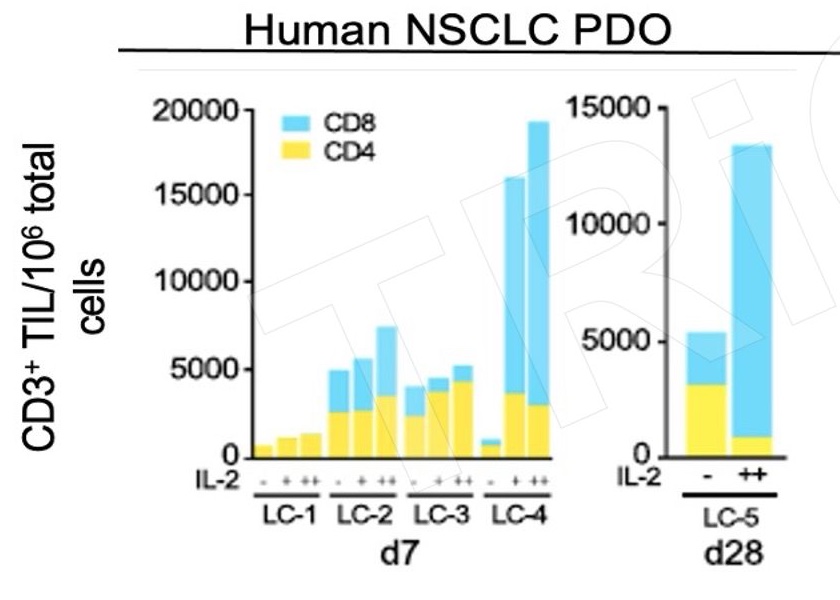 View image
NSCLC immune readouts: CD4/CD8 counts within CD3-positive TIL populations for LC-1 to LC-4 at day 7 and LC-5 at day 28 inform sample selection and IL-2 conditions.
TRiCBIO NSCLC PDO 2.0 study dataContinue to the related case for model context, experimental setup and interpretation.
Study focus
Study workflow
Review tumor type, sample state, prior treatment and the immune process the candidate is intended to change.
Select PDO 2.0 / ALI or a custom co-culture, then confirm tissue identity and measurable immune components.
Combine histology, flow, apoptosis, cytokine or TCR readouts according to mechanism.
Interpret tumor response and immune change against model baseline and define recommended follow-up studies.
Model options
At study start, baseline QC confirms measurable immune components and the culture window, guiding treatment conditions and endpoint selection.
PROJECT DISCUSSION
Tumor type, sample condition, treatment mechanism and the immune response of interest guide the choice of PDO 2.0 / ALI or a custom co-culture, controls and readouts.
Application
Use PDO 2.0 / ALI and project-relevant immune assays to study relationships among immune composition, architecture and treatment response.
PDO 2.0 immune studies
PDO 2.0 studies in ccRCC and NSCLC combine tissue profiling, ICB-related flow readouts and CD4/CD8 measurements under IL-2 conditions to inform sample selection, treatment design and immune endpoints.
View imageTissue and model context: PanCK, CD3 and DAPI imaging compares tumor-epithelial and CD3-positive immune-cell signals across the source tissue and PDO culture time points.
TRiCBIO ccRCC PDO 2.0 immune-context study dataView imageTreatment-related readouts: PD-L1-, CD8- and CD56-associated flow profiles are interpreted alongside early-apoptosis and necrosis measurements to compare immune-associated and cell-death changes under immune-checkpoint blockade.
TRiCBIO ccRCC PDO 2.0 immune-context study dataView imageNSCLC immune readouts: CD4/CD8 counts within CD3-positive TIL populations for LC-1 to LC-4 at day 7 and LC-5 at day 28 inform sample selection and IL-2 conditions.
TRiCBIO NSCLC PDO 2.0 study dataContinue to the related case for model context, experimental setup and interpretation.
Study focus
Study workflow
Review tumor type, sample state, prior treatment and the immune process the candidate is intended to change.
Select PDO 2.0 / ALI or a custom co-culture, then confirm tissue identity and measurable immune components.
Combine histology, flow, apoptosis, cytokine or TCR readouts according to mechanism.
Interpret tumor response and immune change against model baseline and define recommended follow-up studies.
Model options
At study start, baseline QC confirms measurable immune components and the culture window, guiding treatment conditions and endpoint selection.
PROJECT DISCUSSION
Tumor type, sample condition, treatment mechanism and the immune response of interest guide the choice of PDO 2.0 / ALI or a custom co-culture, controls and readouts.