
Tumor sample context
Tumor type, collection site, sample condition, expected timing and available ethics documentation.
Use conventional PDOs for pancreatic epithelial and drug-response studies, with ALI or custom co-culture added when stromal or immune context is important.
Patient pancreatic cancer tissue
PDO · ALI/custom co-culture
TRiCBIO pancreatic cancer PDO culture and study data
Model characterization
Source-tissue and organoid imaging plus lineage/identity markers characterize the model; functional readouts are selected for the candidate mechanism and study objective.
 View image
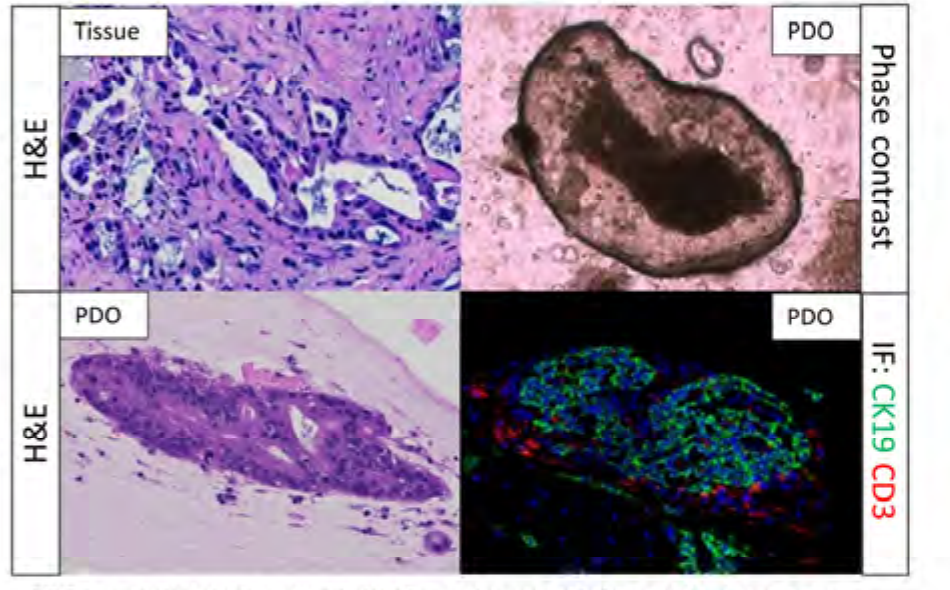
PDAC model identity and tissue context: source-tissue H&E, PDO bright-field and PDO H&E are combined with CK19 and CD3 immunofluorescence to add epithelial and sample-associated T-cell context; measurable components and the assay panel are confirmed during model setup.
TRiCBIO PDAC PDO 2.0 study data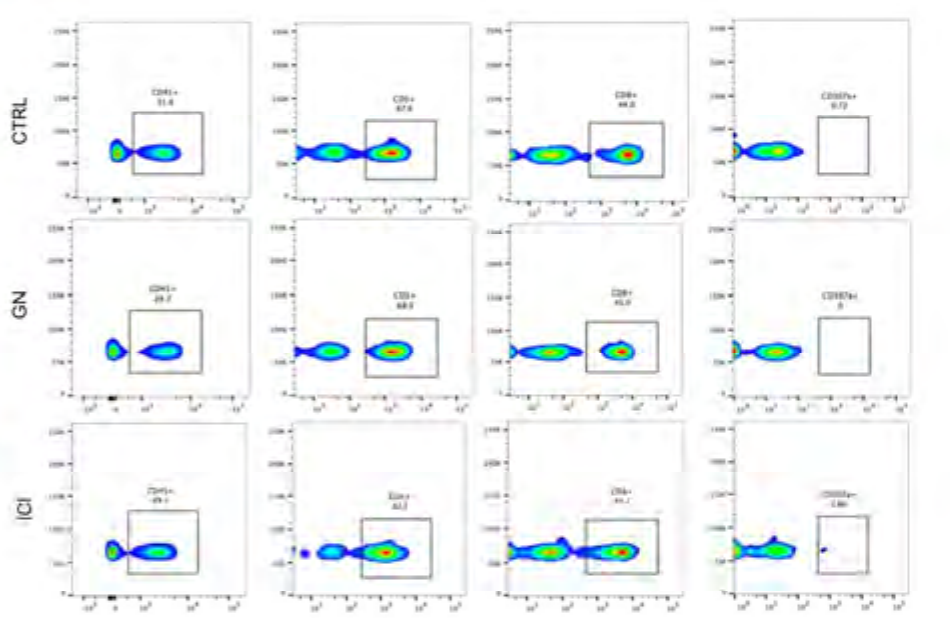 View image
PDAC PDO immune readouts: flow panels assess CD3, CD8 and CD107a populations across conditions, supported by documented treatment definitions, gating, replication and quantitative analysis.
Study dataStudy planning
Tumor type, sample condition, candidate and intended comparison guide the culture format, controls and assays.
Tumor type, collection site, sample condition, expected timing and available ethics documentation.
Modality, dosing plan, controls and the response or comparison the study should address.
Planned histology, flow, molecular or functional assays, together with preferred data and report formats.
Study design
PDAC is dense and sample-variable. Confirm tumor epithelial identity and culture quality, then configure penetration, bystander or immune endpoints around the candidate mechanism.
Review primary or metastatic site, pathology and sample state, then confirm the model with morphology and epithelial markers such as CK19.
Use conventional PDO for tumor-cell efficacy comparisons and add ALI or custom co-culture for tissue penetration, bystander-killing or immune-interaction readouts.
Select viability, apoptosis, histology, penetration imaging and immune readouts according to the small-molecule, ADC, antibody or immune mechanism.
Integrate model identity, drug distribution, killing and microenvironment signals to compare candidates and define the next study.
Research applications
Assays & QC
Characterization combines epithelial markers such as CK19 and histology with immune or functional endpoints selected for the study.
Study & delivery
Choose a supplied model or a TRiCBIO-run study. Typical deliverables include histology, functional data and a study report.
Related solutions
PROJECT DISCUSSION
Tumor type, sample status, candidate profile and comparison endpoints determine the culture format, controls, assay panel and deliverables for the pancreatic cancer PDO.
Use conventional PDOs for pancreatic epithelial and drug-response studies, with ALI or custom co-culture added when stromal or immune context is important.
Patient pancreatic cancer tissue
PDO · ALI/custom co-culture
TRiCBIO pancreatic cancer PDO culture and study data
Model characterization
Source-tissue and organoid imaging plus lineage/identity markers characterize the model; functional readouts are selected for the candidate mechanism and study objective.
View imagePDAC model identity and tissue context: source-tissue H&E, PDO bright-field and PDO H&E are combined with CK19 and CD3 immunofluorescence to add epithelial and sample-associated T-cell context; measurable components and the assay panel are confirmed during model setup.
TRiCBIO PDAC PDO 2.0 study dataView imagePDAC PDO immune readouts: flow panels assess CD3, CD8 and CD107a populations across conditions, supported by documented treatment definitions, gating, replication and quantitative analysis.
Study dataStudy planning
Tumor type, sample condition, candidate and intended comparison guide the culture format, controls and assays.
Tumor type, collection site, sample condition, expected timing and available ethics documentation.
Modality, dosing plan, controls and the response or comparison the study should address.
Planned histology, flow, molecular or functional assays, together with preferred data and report formats.
Study design
PDAC is dense and sample-variable. Confirm tumor epithelial identity and culture quality, then configure penetration, bystander or immune endpoints around the candidate mechanism.
Review primary or metastatic site, pathology and sample state, then confirm the model with morphology and epithelial markers such as CK19.
Use conventional PDO for tumor-cell efficacy comparisons and add ALI or custom co-culture for tissue penetration, bystander-killing or immune-interaction readouts.
Select viability, apoptosis, histology, penetration imaging and immune readouts according to the small-molecule, ADC, antibody or immune mechanism.
Integrate model identity, drug distribution, killing and microenvironment signals to compare candidates and define the next study.
Research applications
Assays & QC
Characterization combines epithelial markers such as CK19 and histology with immune or functional endpoints selected for the study.
Study & delivery
Choose a supplied model or a TRiCBIO-run study. Typical deliverables include histology, functional data and a study report.
Related solutions
PROJECT DISCUSSION
Tumor type, sample status, candidate profile and comparison endpoints determine the culture format, controls, assay panel and deliverables for the pancreatic cancer PDO.