
Candidate and study goal
Define the target, mechanism and development stage, then determine whether the study will screen or rank candidates or investigate the basis of response.
Application
Compare candidates across doses, time points and combinations in models selected for the target and indication, using mechanism-linked readouts to explain differences.
Model context and treatment response
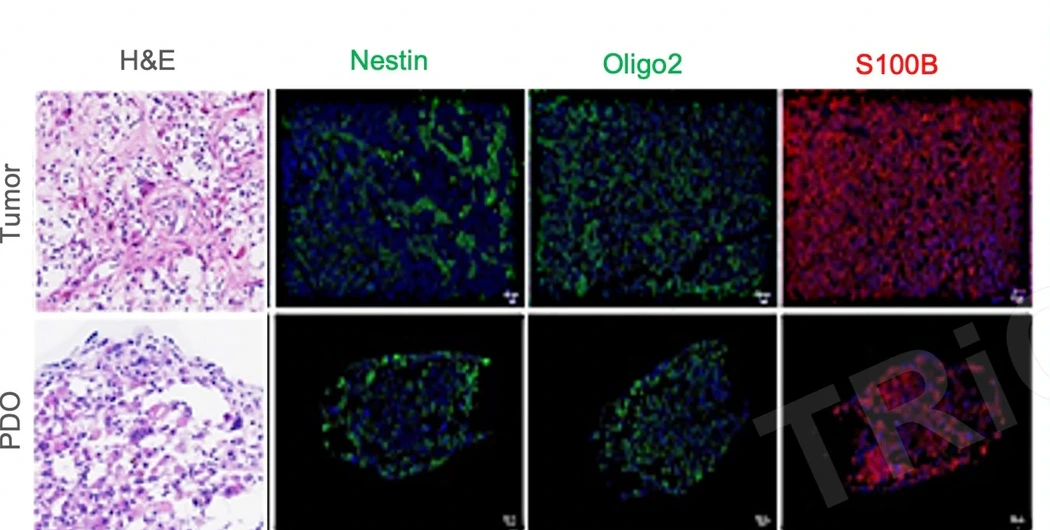
Glioma PDO 2.0 evidence pairs source-tissue/PDO histology and lineage profiling with apoptosis and necrosis across inhibitor concentrations. New studies can extend this approach to candidate-specific dose, timing, combination and mechanism readouts.
 View image
Model and lineage context: source-tissue/PDO histology with Nestin, Olig2 and S100B profiling establishes glioma-model features for candidate and mechanism studies.
TRiCBIO glioma PDO 2.0 study data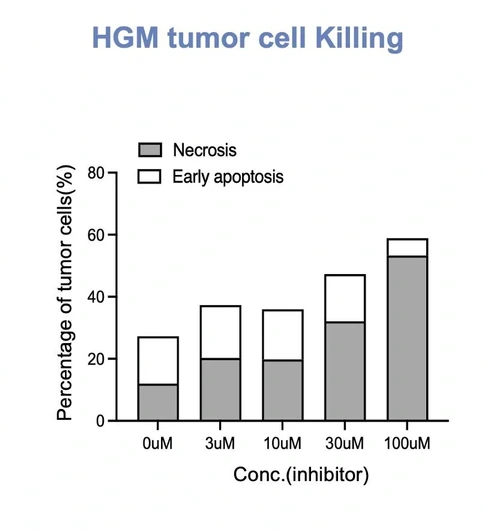 View image
Treatment response: early-apoptosis and necrosis readouts across inhibitor concentrations show dose-related changes and guide replication, combination and mechanism studies.
TRiCBIO glioma PDO 2.0 study dataContinue to the related case for model context, experimental setup and interpretation.
Study focus
Study workflow
Define the target, mechanism and development stage, then determine whether the study will screen or rank candidates or investigate the basis of response.
Select a biologically relevant model and confirm model performance, vehicle tolerance, positive-control response and assay window.
Use dose series, time points or combination matrices with consistent viability, morphology and mechanism-linked readouts.
Confirm initial hits and rank candidates using potency, maximum effect, selectivity and data quality.
Model options
Plate format, throughput, dose range and hit criteria are adapted to the model and candidate; in vitro results support candidate comparison and the design of follow-on in vivo validation.
PROJECT DISCUSSION
The target, indication, candidate set and current dose, combination or mechanism question guide model selection, controls and study endpoints.
Application
Compare candidates across doses, time points and combinations in models selected for the target and indication, using mechanism-linked readouts to explain differences.
Model context and treatment response
Glioma PDO 2.0 evidence pairs source-tissue/PDO histology and lineage profiling with apoptosis and necrosis across inhibitor concentrations. New studies can extend this approach to candidate-specific dose, timing, combination and mechanism readouts.
View imageModel and lineage context: source-tissue/PDO histology with Nestin, Olig2 and S100B profiling establishes glioma-model features for candidate and mechanism studies.
TRiCBIO glioma PDO 2.0 study dataView imageTreatment response: early-apoptosis and necrosis readouts across inhibitor concentrations show dose-related changes and guide replication, combination and mechanism studies.
TRiCBIO glioma PDO 2.0 study dataContinue to the related case for model context, experimental setup and interpretation.
Study focus
Study workflow
Define the target, mechanism and development stage, then determine whether the study will screen or rank candidates or investigate the basis of response.
Select a biologically relevant model and confirm model performance, vehicle tolerance, positive-control response and assay window.
Use dose series, time points or combination matrices with consistent viability, morphology and mechanism-linked readouts.
Confirm initial hits and rank candidates using potency, maximum effect, selectivity and data quality.
Model options
Plate format, throughput, dose range and hit criteria are adapted to the model and candidate; in vitro results support candidate comparison and the design of follow-on in vivo validation.
PROJECT DISCUSSION
The target, indication, candidate set and current dose, combination or mechanism question guide model selection, controls and study endpoints.