
Tumor sample context
Tumor type, collection site, sample condition, expected timing and available ethics documentation.
Patient-derived breast tumor organoids for single-agent and combination studies, with PDO 2.0 / ALI considered when immune context is relevant.
Patient breast tumor tissue, with sample quality and subtype incorporated into model planning
PDO 1.0 · PDO 2.0 / ALI study format
TRiCBIO culture, passaging and study data
Model characterization
Source-tissue and organoid imaging plus lineage/identity markers characterize the model; functional readouts are selected for the candidate mechanism and study objective.
 View image
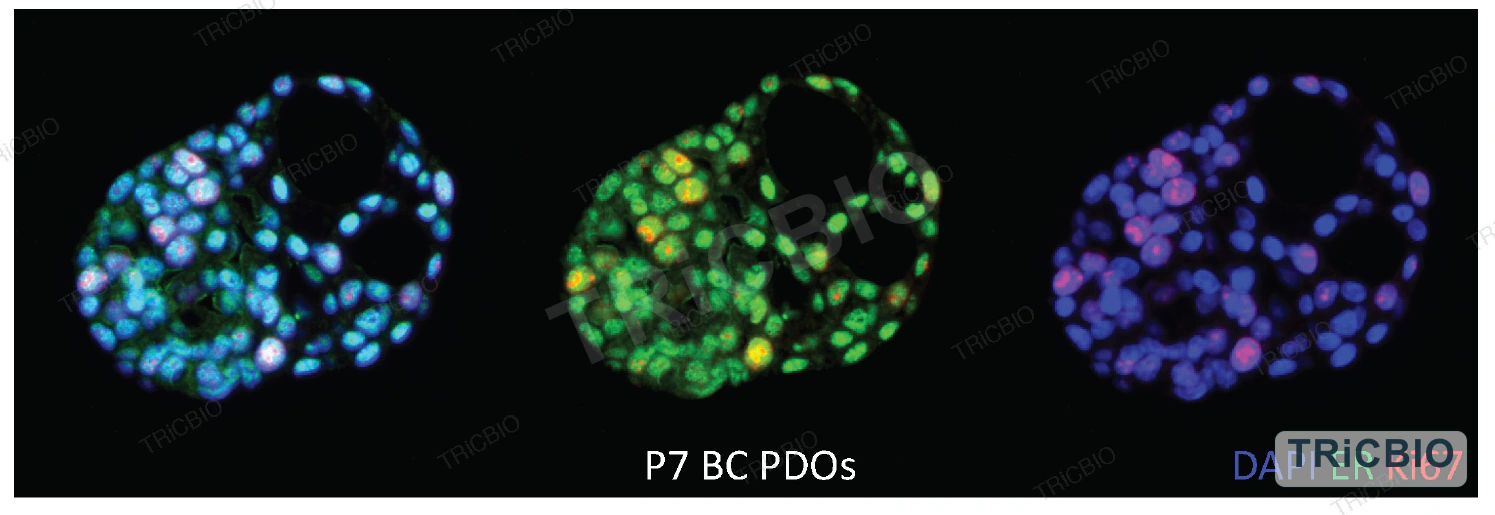
Receptor and proliferation phenotype: DAPI, ER and Ki67 show nuclear, receptor-associated and proliferative features in this breast PDO and provide a baseline for subtype-informed study design.
Model & assay data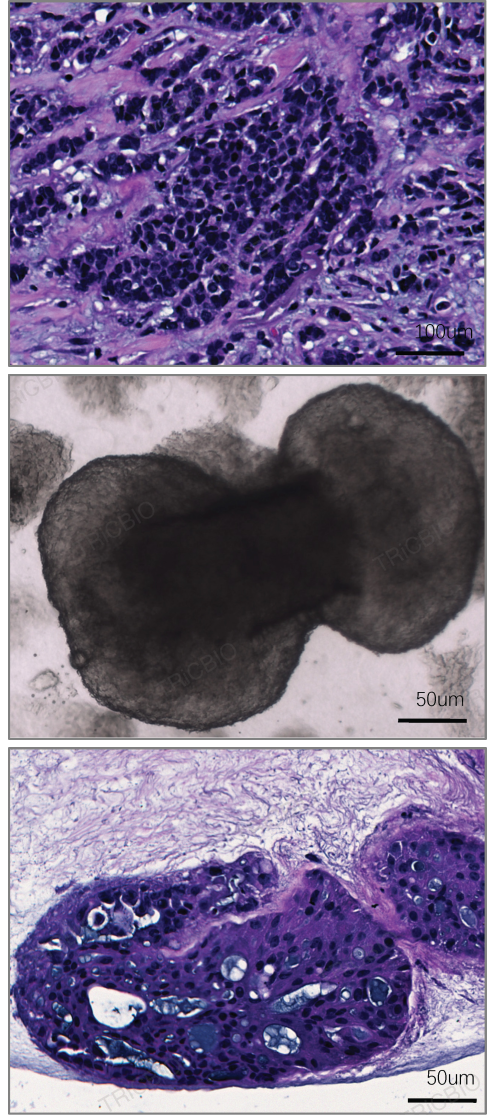 View image
Source tissue and PDO: source-tissue H&E, PDO bright-field and PDO histology are viewed together to assess morphological correspondence in this model.
Model & assay dataStudy planning
Tumor type, sample condition, candidate and intended comparison guide the culture format, controls and assays.
Tumor type, collection site, sample condition, expected timing and available ethics documentation.
Modality, dosing plan, controls and the response or comparison the study should address.
Planned histology, flow, molecular or functional assays, together with preferred data and report formats.
Study design
Molecular subtype, sampling site and prior treatment directly shape breast PDO studies. Study design integrates source-tissue context, receptor phenotype, model identity and culture quality, and drug mechanism.
Review ER, PR and HER2 context, primary or metastatic site, sampling method and prior treatment to define the decision.
Choose around candidate mechanism, required cellular context, spatial information and endpoints; the two systems can also be used sequentially or in parallel.
Set dose, timing, positive/negative controls and combinations around small molecules, antibodies, ADCs or immunotherapies.
Compare candidates using receptor and proliferation markers, histology, viability, cytokines or flow in context.
Research applications
Assays & QC
QC combines tissue morphology, receptor/proliferation markers and project-relevant functional readouts.
Study & delivery
Choose model establishment, expansion or a TRiCBIO-run efficacy study. Typical deliverables include raw data and an analysis report.
Related solutions
PROJECT DISCUSSION
Tumor type, sample status, candidate profile and comparison endpoints determine the culture format, controls, assay panel and deliverables for the breast cancer PDO.
Patient-derived breast tumor organoids for single-agent and combination studies, with PDO 2.0 / ALI considered when immune context is relevant.
Patient breast tumor tissue, with sample quality and subtype incorporated into model planning
PDO 1.0 · PDO 2.0 / ALI study format
TRiCBIO culture, passaging and study data
Model characterization
Source-tissue and organoid imaging plus lineage/identity markers characterize the model; functional readouts are selected for the candidate mechanism and study objective.
View imageReceptor and proliferation phenotype: DAPI, ER and Ki67 show nuclear, receptor-associated and proliferative features in this breast PDO and provide a baseline for subtype-informed study design.
Model & assay dataView imageSource tissue and PDO: source-tissue H&E, PDO bright-field and PDO histology are viewed together to assess morphological correspondence in this model.
Model & assay dataStudy planning
Tumor type, sample condition, candidate and intended comparison guide the culture format, controls and assays.
Tumor type, collection site, sample condition, expected timing and available ethics documentation.
Modality, dosing plan, controls and the response or comparison the study should address.
Planned histology, flow, molecular or functional assays, together with preferred data and report formats.
Study design
Molecular subtype, sampling site and prior treatment directly shape breast PDO studies. Study design integrates source-tissue context, receptor phenotype, model identity and culture quality, and drug mechanism.
Review ER, PR and HER2 context, primary or metastatic site, sampling method and prior treatment to define the decision.
Choose around candidate mechanism, required cellular context, spatial information and endpoints; the two systems can also be used sequentially or in parallel.
Set dose, timing, positive/negative controls and combinations around small molecules, antibodies, ADCs or immunotherapies.
Compare candidates using receptor and proliferation markers, histology, viability, cytokines or flow in context.
Research applications
Assays & QC
QC combines tissue morphology, receptor/proliferation markers and project-relevant functional readouts.
Study & delivery
Choose model establishment, expansion or a TRiCBIO-run efficacy study. Typical deliverables include raw data and an analysis report.
Related solutions
PROJECT DISCUSSION
Tumor type, sample status, candidate profile and comparison endpoints determine the culture format, controls, assay panel and deliverables for the breast cancer PDO.