
Programs testing whether target modulation changes a human-relevant phenotype, function or pathway.
R&D service
Target validation & mechanism studies
Determine how target modulation changes disease-relevant phenotypes, molecular pathways and treatment response in human organoid models.
 View image
Model foundation for target studies
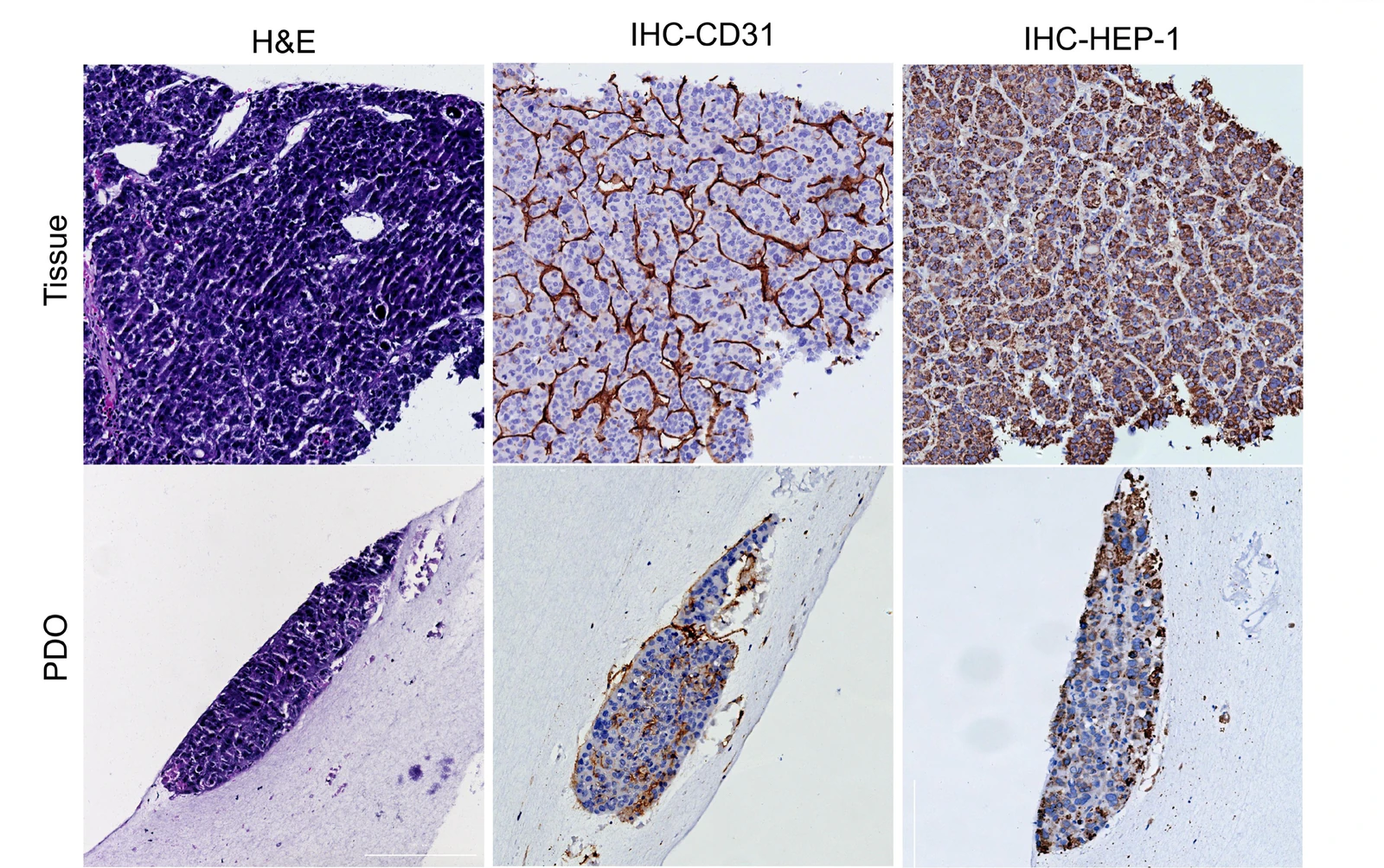
Begin target studies with model identity and tissue context
H&E histology plus CD31 and HEP-1 immunohistochemistry in HCC source tissue and PDO establish tissue architecture, vascular-marker patterns and hepatic lineage. Each program then adds target expression, genetic or pharmacologic perturbation, target engagement, pathway and functional assays.
Study focus
What this study can help you decide
- 01How does target modulation affect the key phenotype?
- 02How do effects vary across tissues or samples?
- 03Which findings support the next experiment or program decision?
STUDY APPROACH
Match the model and assays to your program
Match tumor, disease or normal-tissue organoids to the target cell and disease context. Consider PDO 2.0 when tissue architecture or immune factors are central to the study.
Combine perturbation efficiency and target engagement with functional, pathway and dose-related readouts selected for the target and model.
Use orthogonal perturbation, negative controls and, where feasible, rescue or mechanism-relevant positive controls.
Assess the evidence for target progression and prioritize independent-sample, orthogonal, mechanism or in vivo validation.
Study workflow
Validate target modulation through human-relevant phenotypes
Target validation starts with the development hypothesis and relates expression change to functional phenotype, orthogonal perturbation, appropriate controls and pathway–dose relationships. Human-relevant disease or tumor models build the evidence needed for program decisions.
Target hypothesis and decision criteria
Define target cell type, expected phenotype, direction of effect and evidence needed for the next decision, with progression and optimization criteria agreed upfront.
Model and baseline assessment
Select the model by tissue source, disease phenotype and target expression, then confirm the pretreatment state with histologic, functional or molecular readouts.
Orthogonal perturbation and controls
Use pharmacologic, antibody, RNA or other suitable genetic-perturbation approaches with non-targeting, vector, vehicle and appropriate positive controls.
Phenotype–pathway–dose assessment
Integrate functional phenotype, target engagement or perturbation, downstream pathway and dose/time relationships to distinguish target effects from nonspecific injury.
Target study design
Connect target perturbation to molecular, functional and treatment readouts
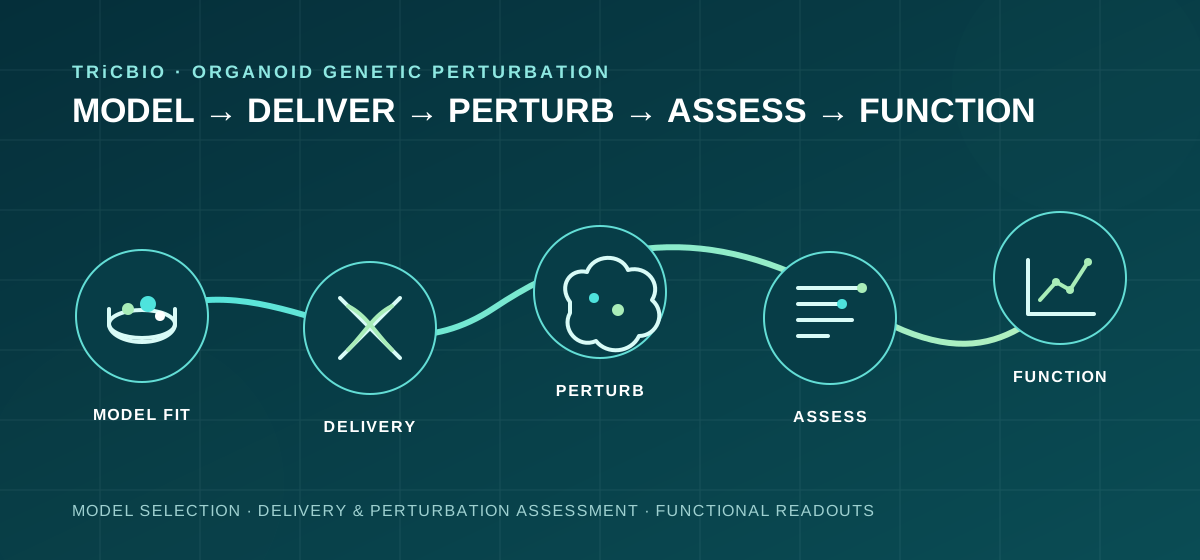
The study begins with a suitable model and delivery conditions, then connects genetic or pharmacologic perturbation with molecular confirmation, functional phenotype and treatment response to validate the target and shape follow-on mechanism work.
 View image
Select the model and delivery conditions, confirm perturbation performance and model quality, then advance to phenotype, mechanism and treatment-response assays.
Study design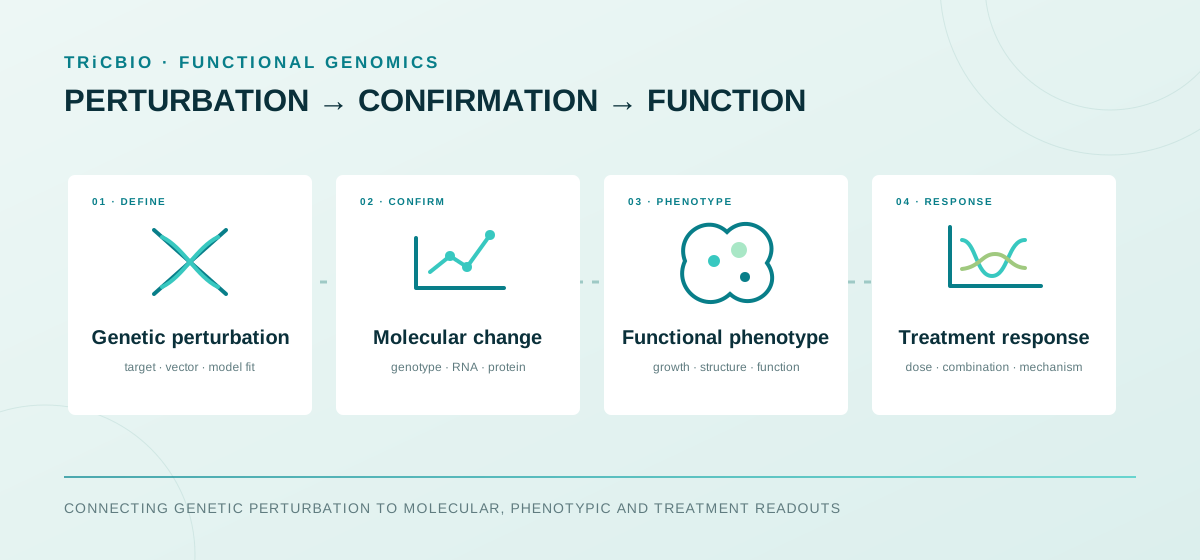 View image
A target-focused study connects genetic or pharmacologic perturbation with target confirmation, pathway change, functional phenotype and treatment response.
Study designExpected study outputs
What you receive
Target and model strategy
The rationale for model selection, target baseline and perturbation approach, with delivery or assay-development priorities.
Orthogonal perturbation and functional data
Perturbation efficiency, functional phenotypes, pathway readouts and control results from the prespecified assay plan.
Recommendations for the next study
Recommendations to advance the program, refine the design or focus the next experiment, linked to predefined decision criteria.
Relevant model systems
Recommended model systems
TRiCBIO brings human organoids, disease phenotypes, multimodal assays and custom genetic perturbation into target-focused studies. Each program defines delivery and perturbation performance, model suitability and the statistical plan.
PROJECT DISCUSSION
Plan a target and mechanism study
Tell us the target, planned intervention, phenotype or pathway of interest, and available models or samples. Our scientists will shape the functional and mechanism study around them.