
From organoids to in vivo validation
PDOX in vivo validation
Extend selected patient-derived organoid (PDO) findings into xenograft studies to compare tumor growth, pharmacology and mechanism-related readouts across models.
PDO-to-PDOX translational evidence
Extend PDO identity and in vitro findings into in vivo validation
PDO and PDOX studies combine model identity, histology and study endpoints. In vitro evidence, engraftment performance and prespecified criteria inform which models advance to in vivo studies.
 View image
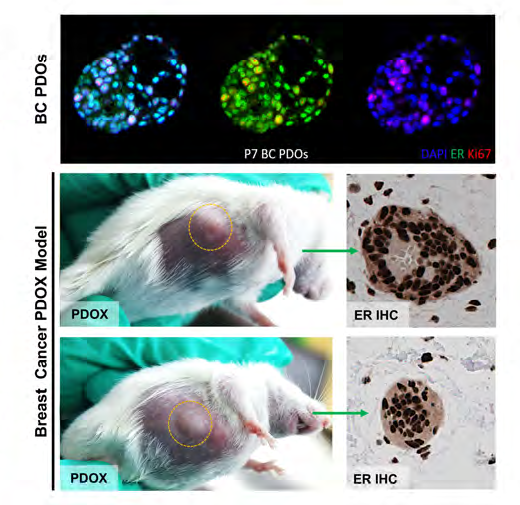
Identity from in vitro to in vivo: ER and Ki67 staining in a breast cancer PDO is shown alongside ER immunohistochemistry in PDOX tissue to compare receptor phenotype and model identity.
Study dataView the PDO and PDOX phenotype study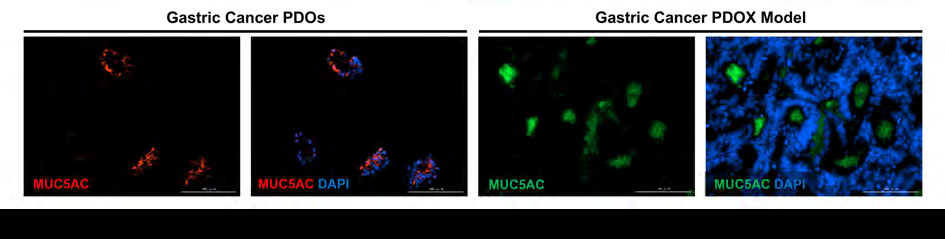 View image
In vitro/in vivo phenotype in a gastric cancer model: MUC5AC immunofluorescence compares marker distribution in PDO and PDOX and provides a phenotype baseline for in vivo extension.
Study dataView the PDO and PDOX phenotype studyStudy applications
When in vivo extension adds value
Assess in vivo growth or histology
Compare key efficacy or mechanism findings in vitro and in vivo
Study workflow
Move from PDO findings into a PDOX study
PDO identity and study selection
Confirm model source, morphology, key markers and in vitro evidence.
In vivo study design
Define animal, implantation route, observation period, groups and primary endpoints.
Growth and histologic validation
Track in vivo growth and confirm identity using H&E or project-relevant markers.
In vitro–in vivo comparison
Compare key efficacy, histologic or mechanism signals across both systems.
Deliverables
Receive in vivo growth, histology and efficacy results
- PDOX model-selection and study plan
- Growth, histology and project endpoint data
- In vitro–in vivo comparison and report
Related models
Select the model by biological context
PDOX projects evaluate model selection and engraftment performance, with study duration and endpoints defined by the in vitro–in vivo plan.
PROJECT DISCUSSION
Extend PDO findings into a PDOX study
Share the PDO findings, candidate model, treatment and in vivo endpoints you want to confirm. Together we can define model selection, study groups, assays and scope.