
Mouse intestinal organoids are characterized through epithelial morphology and F-actin/ZO-1 junction structure.
IBD inflammation and barrier organoid model
For inflammatory bowel disease (IBD), established inflammation and barrier assays in mouse intestinal organoids support candidate comparison across morphology, permeability, viability and F-actin/ZO-1; we tailor a human study to the sample and program goal.
ZO-1F-actin
Model source
TRiCBIO mouse intestinal organoid inflammation and barrier-assay data, with human IBD programs tailored to the sample
Culture / format
3D intestinal organoid · Imaging-based endpoints
Supporting evidence
TRiCBIO mouse intestinal organoid inflammation and barrier assay data
Model characterization
How the model is established and characterized
Disease-associated morphology, barrier or functional readouts characterize the model phenotype and guide intervention and endpoint design.
 View image
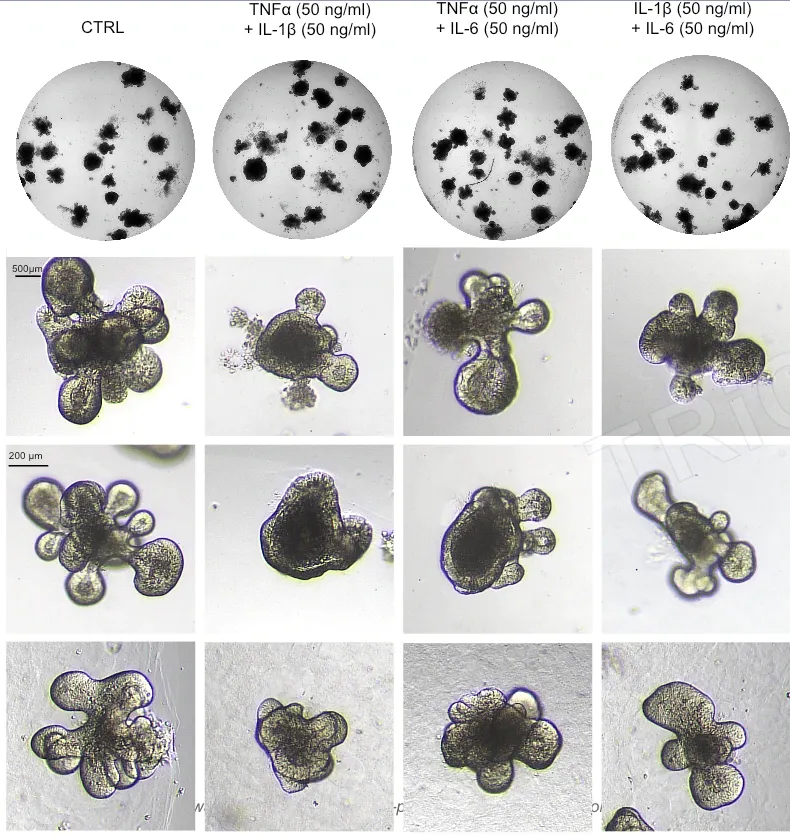
Morphology and budding: mouse intestinal organoids are compared across control and inflammatory cytokine conditions.
TRiCBIO mouse intestinal organoid study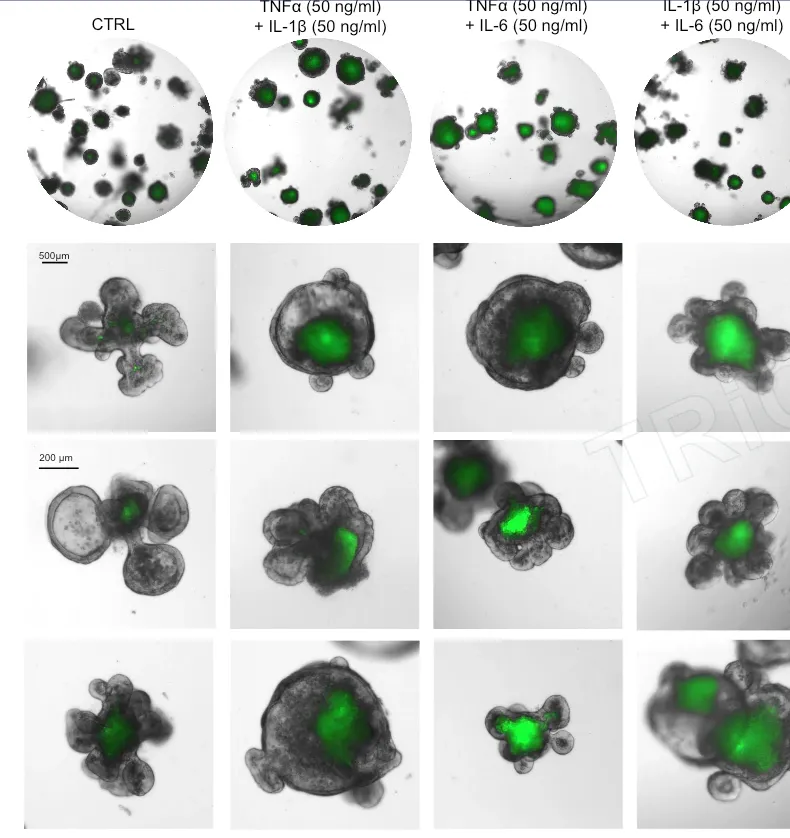 View image
Barrier permeability: FITC-Dextran imaging visualizes relative luminal fluorescence in mouse intestinal organoids across inflammatory conditions.
TRiCBIO mouse intestinal organoid study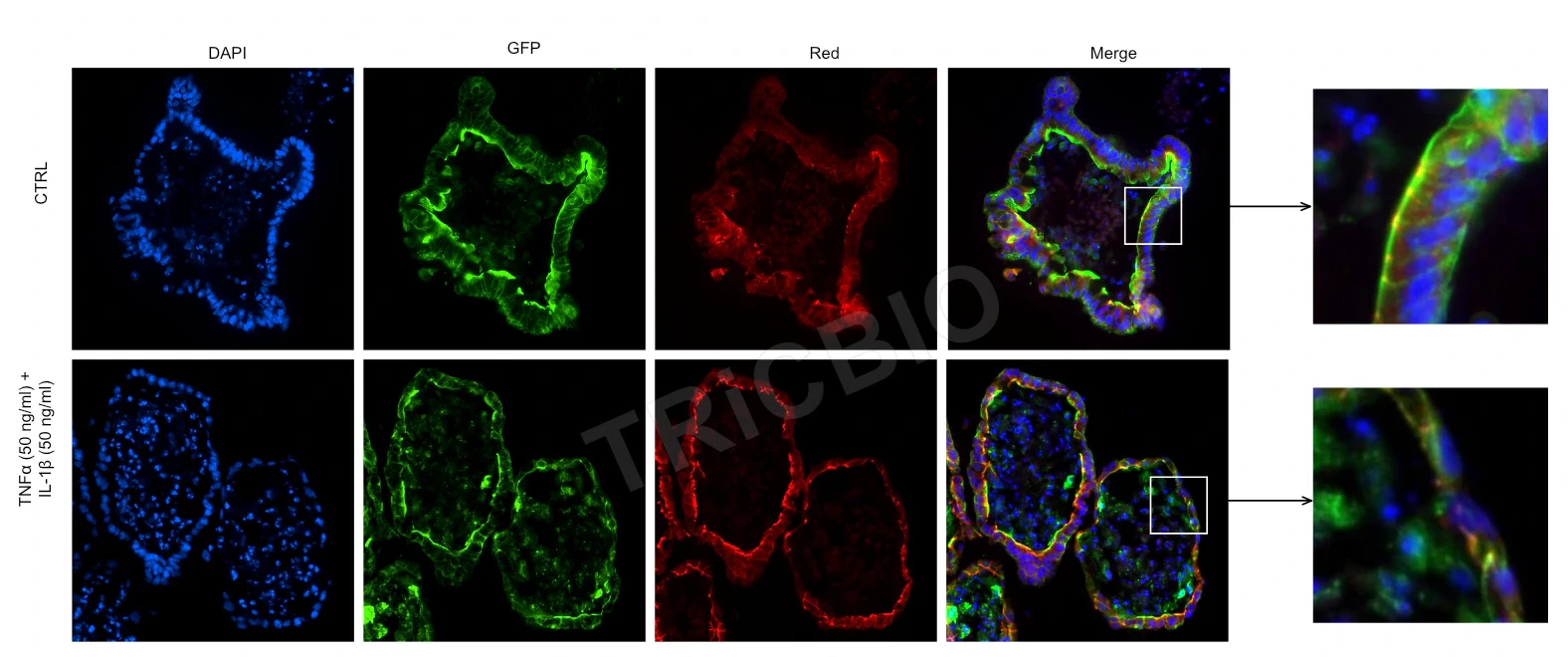 View image
Cytoskeleton and tight junctions: F-actin and ZO-1 immunofluorescence provides epithelial-structure and junction-status readouts.
TRiCBIO mouse intestinal organoid studyHUMAN INTESTINAL ORGANOID CULTURE
View on PubMed ↗Engineered Matrices Enable the Culture of Human Patient-Derived Intestinal Organoids
This peer-reviewed study describes engineered matrices for culturing human patient-derived intestinal organoids and complements the inflammation and barrier assays used in sample-tailored IBD studies.
Model documentation
Model profile and available documentation
We combine inflammatory challenge, FITC-Dextran permeability and viability in the mouse model, then tailor functional assays to the sample for human IBD studies.
Mouse intestinal organoid inflammation and barrier-assay data cover morphology, permeability and junction structure; human IBD studies are tailored to the sample, candidate and study objective.
You receive a model summary, study design, original images/data and integrated analysis.
Study planning
From study objective to model and assay plan
Disease phenotype, available models or samples, the intervention and study hypothesis guide induction conditions and readouts.
Disease phenotype and objective
Phenotype, induction condition, intervention strategy and primary hypothesis.
Samples and candidate
Sample source, available model information, candidate intervention and controls.
Assays and deliverables
Morphology, barrier, molecular or functional readouts, together with data and reporting needs.
Study design
Move from mouse intestinal organoid methods to candidate evaluation and tailored human IBD studies
Mouse intestinal organoid studies combine inflammatory induction, budding, FITC-Dextran permeability, viability and F-actin/ZO-1 junction structure to assess epithelial injury and recovery; human IBD programs are tailored to the available sample, candidate and research goal.
Choose a mouse method or tailored human study
Use mouse intestinal organoid assays for candidate studies or design a human IBD program around the available sample, then define the inflammatory conditions and dosing sequence.
Confirm the injury phenotype
Compare budding, epithelial wall thickness, FITC-Dextran permeability, viability and ZO-1/F-actin organization.
Assess candidate intervention
Compare dose, timing and controls within a consistent inflammatory background to see whether permeability, junction structure and cell state improve together.
Interpret protection or repair
Interpret permeability, tight junctions, morphology and viability together to distinguish survival from barrier restoration.
Research applications
Recommended applications
- Inflammation and barrier injury
- Candidate protection or repair
- Epithelial junction and functional phenotypes
Assays & QC
Disease phenotype and intervention readouts
Key markers
ZO-1F-actin
Available assays
- FITC-Dextran
- Calcein AM
- Morphometry
QC approach
Budding morphology, permeability, viability and junction structure form a coherent barrier and injury profile.
Study & delivery
Disease-phenotype study design and deliverables
Run candidate studies with the mouse method and receive images, quantitative results, methods and a report; human IBD programs are designed around the available sample.
Related solutions
Related study options
PROJECT DISCUSSION
Discuss an IBD study
Disease phenotype, induction or intervention conditions and the primary hypothesis determine model conditions, assays and stage-specific readouts for the IBD inflammation and barrier organoid model.