
Barrier and delivery question
Define tissue interface, candidate format and whether the question is transport, retention, injury or repair.
Application
Confirm barrier structure and baseline function, then interpret candidate transport or retention alongside barrier-integrity readouts.
Barrier structure and permeability
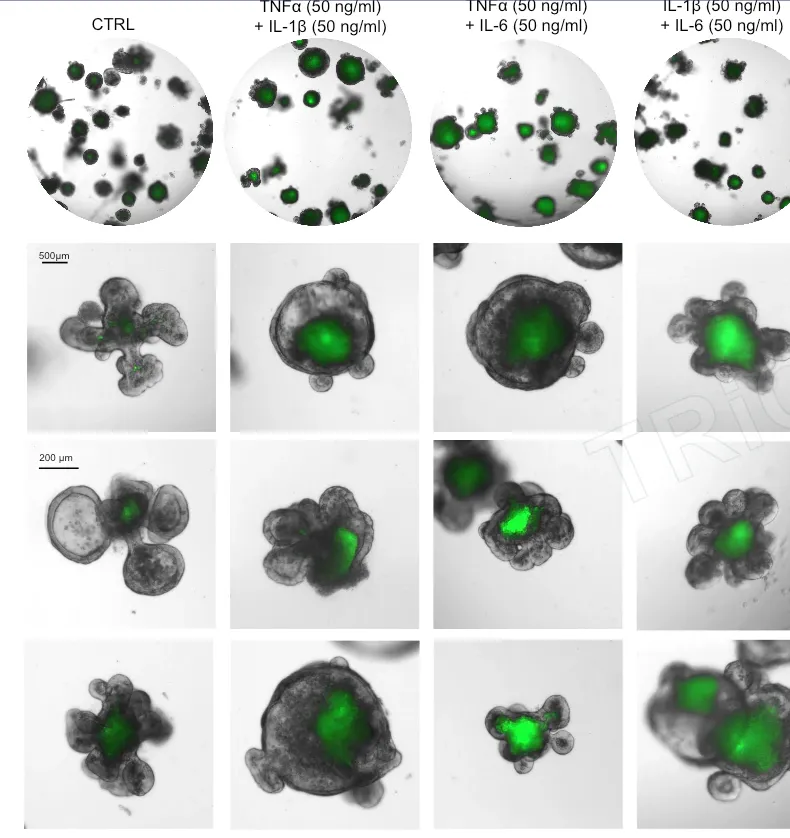
Mouse intestinal organoid evidence combines FITC-Dextran permeability, F-actin/ZO-1 and tissue-function readouts to characterize epithelial barrier state. Human inflammatory bowel disease and blood–brain barrier studies can then be tailored to the available samples, cell system and required functional endpoints.
 View image
Barrier permeability: FITC-Dextran imaging visualizes relative luminal fluorescence in mouse intestinal organoids across inflammatory conditions.
TRiCBIO mouse intestinal organoid study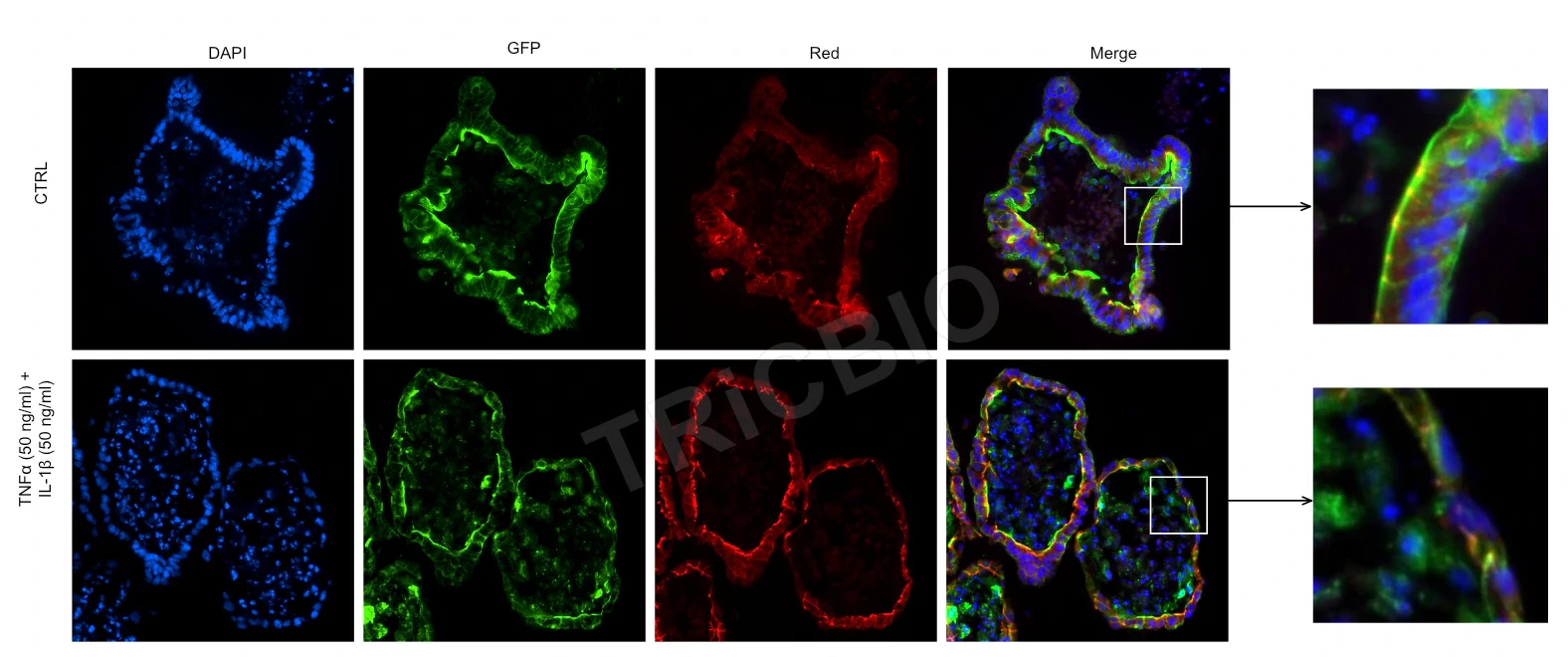 View image
Cytoskeleton and tight junctions: F-actin and ZO-1 immunofluorescence provides epithelial-structure and junction-status readouts.
TRiCBIO mouse intestinal organoid studyContinue to the related case for model context, experimental setup and interpretation.
Study focus
Study workflow
Define tissue interface, candidate format and whether the question is transport, retention, injury or repair.
Confirm cell identity, tight junctions, baseline permeability and acceptance criteria.
Define orientation, time, concentration, recovery and controls with appropriate tracing or quantification.
Interpret permeability with viability, morphology and junction markers to build an integrated view of transport, retention and barrier status.
Model options
Intestinal organoids support barrier-function and inflammation studies, while blood–brain barrier programs use co-development to configure the cell system and functional endpoints. Permeability can be interpreted with recovery, mass balance and barrier integrity to guide follow-on in vivo work.
PROJECT DISCUSSION
Tell us about the candidate or formulation, the target barrier and the exposure direction. We’ll recommend the model and the permeability and barrier-integrity readouts needed to assess transport, retention or barrier effects.
Application
Confirm barrier structure and baseline function, then interpret candidate transport or retention alongside barrier-integrity readouts.
Barrier structure and permeability
Mouse intestinal organoid evidence combines FITC-Dextran permeability, F-actin/ZO-1 and tissue-function readouts to characterize epithelial barrier state. Human inflammatory bowel disease and blood–brain barrier studies can then be tailored to the available samples, cell system and required functional endpoints.
View imageBarrier permeability: FITC-Dextran imaging visualizes relative luminal fluorescence in mouse intestinal organoids across inflammatory conditions.
TRiCBIO mouse intestinal organoid studyView imageCytoskeleton and tight junctions: F-actin and ZO-1 immunofluorescence provides epithelial-structure and junction-status readouts.
TRiCBIO mouse intestinal organoid studyContinue to the related case for model context, experimental setup and interpretation.
Study focus
Study workflow
Define tissue interface, candidate format and whether the question is transport, retention, injury or repair.
Confirm cell identity, tight junctions, baseline permeability and acceptance criteria.
Define orientation, time, concentration, recovery and controls with appropriate tracing or quantification.
Interpret permeability with viability, morphology and junction markers to build an integrated view of transport, retention and barrier status.
Model options
Intestinal organoids support barrier-function and inflammation studies, while blood–brain barrier programs use co-development to configure the cell system and functional endpoints. Permeability can be interpreted with recovery, mass balance and barrier integrity to guide follow-on in vivo work.
PROJECT DISCUSSION
Tell us about the candidate or formulation, the target barrier and the exposure direction. We’ll recommend the model and the permeability and barrier-integrity readouts needed to assess transport, retention or barrier effects.