
Inflammation-associated changes in morphology, permeability and junction structure help select endpoints and controls for subsequent candidate studies.
Model & assay dataModel and assay
IBD organoid inflammation & barrier assays
Support inflammatory bowel disease (IBD) study design with mouse intestinal organoid budding, FITC-Dextran permeability and F-actin/ZO-1 junction structure; human IBD studies are tailored to the sample and goal.
01Study objective02Model & design03Assays & findings04Decision & next step
Model & sampleMouse intestinal organoid method under inflammatory-cytokine conditions
ObjectiveAssess inflammatory effects on morphology, barrier and cell state
Study conditionsTNFα-, IL-1β- and IL-6-associated inflammatory conditions
AssaysMorphology, FITC-Dextran, Calcein AM, F-actin and ZO-1
Study evidenceTRiCBIO mouse intestinal organoid method and assay data
DeliverablesReceive images, assay results and an analysis summary; the report documents the study design, sample size and statistical methods
01MorphologyBudding and wall thickness
02BarrierFITC-Dextran · ZO-1
03Cell stateCalcein AM · F-actin
04Study extensionCandidate & mechanism endpoints
INFLAMMATION & BARRIER READOUTS
Follow inflammatory injury across barrier structure and function
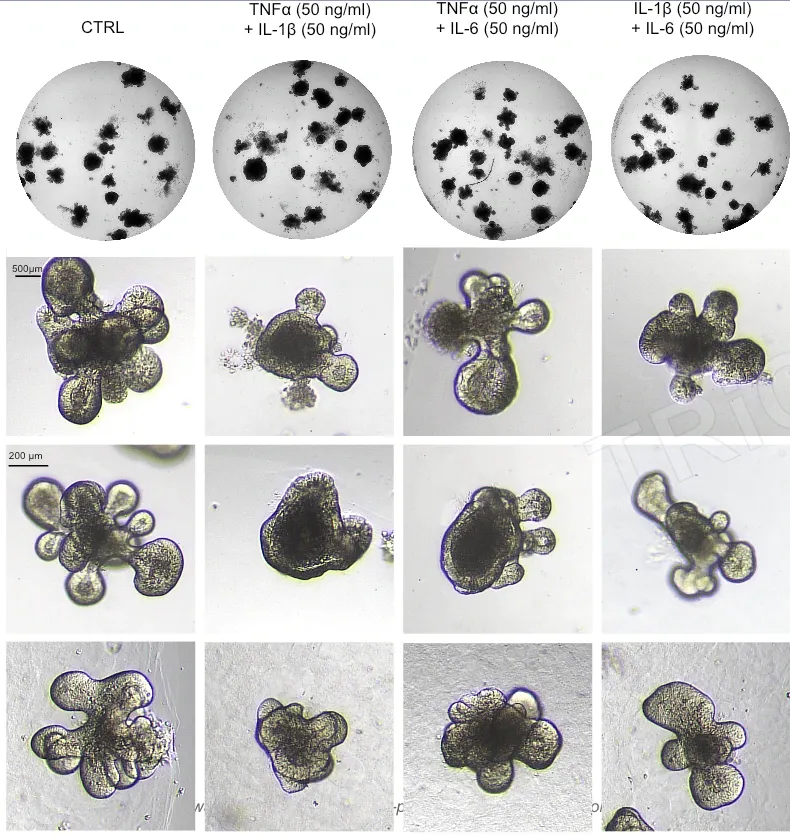
Morphology and budding, FITC-Dextran permeability, and F-actin/ZO-1 junction structure show how inflammatory-cytokine treatment affects intestinal epithelial architecture and barrier function.
 View image
Morphology and budding: mouse intestinal organoids are compared across control and inflammatory cytokine conditions.
TRiCBIO mouse intestinal organoid study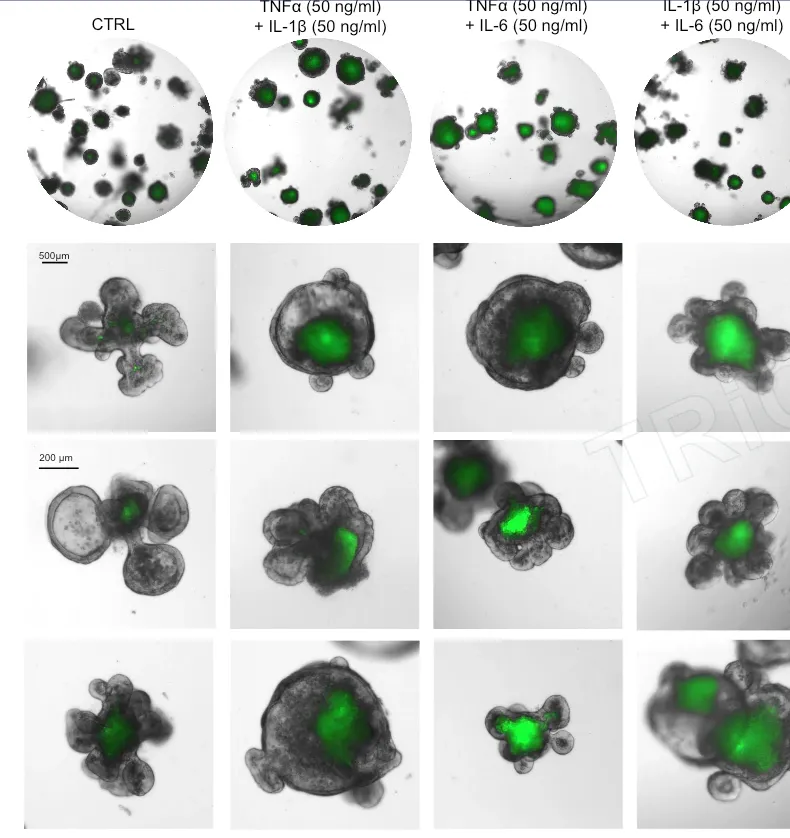 View image
Barrier permeability: FITC-Dextran imaging visualizes relative luminal fluorescence in mouse intestinal organoids across inflammatory conditions.
TRiCBIO mouse intestinal organoid study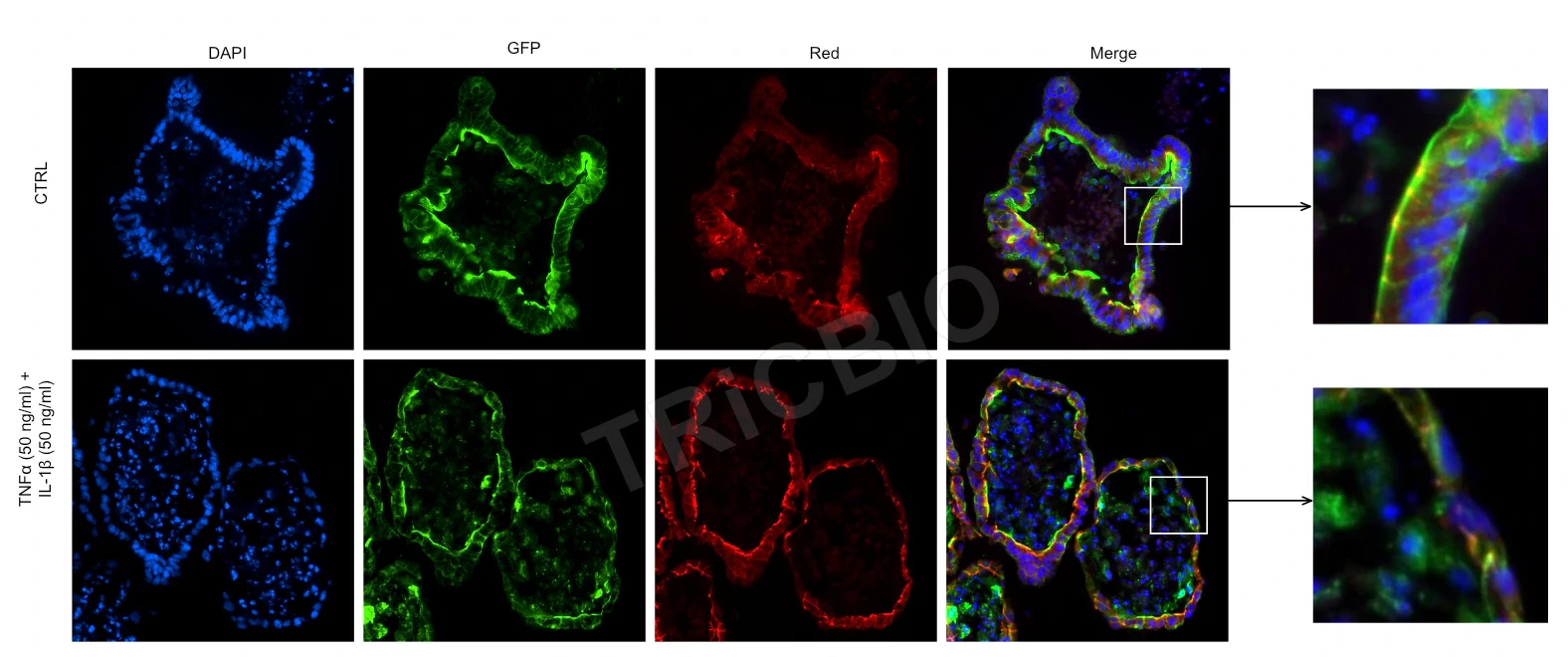 View image
Cytoskeleton and tight junctions: F-actin and ZO-1 immunofluorescence provides epithelial-structure and junction-status readouts.
TRiCBIO mouse intestinal organoid studyHUMAN INTESTINAL ORGANOID CULTURE
View on PubMed ↗Engineered Matrices Enable the Culture of Human Patient-Derived Intestinal Organoids
This peer-reviewed study describes engineered matrices for culturing human patient-derived intestinal organoids and complements the inflammation and barrier assays used in sample-tailored IBD studies.
Assess inflammation, barrier injury and cell state
Mouse intestinal organoid assays evaluate morphology, barrier integrity and cell state side by side after inflammatory-cytokine treatment.
Establishing inflammation
TNFα, IL-1β and IL-6 create an inflammatory condition, with treated and control organoids compared side by side. Budding, overall morphology and epithelial wall thickness provide the first layer of evidence.
- Organoid budding and morphology
- Epithelial wall thickness
- Treatment-to-control comparison
Testing barrier integrity
FITC-Dextran tracks permeability. F-actin and ZO-1 immunofluorescence help show whether cytoskeletal organization and tight-junction structure remain intact.
- FITC-Dextran permeability
- F-actin organization
- ZO-1 tight junctions
Cell state and study extensions
Calcein AM reflects cell viability. Candidate mechanism can guide additional inflammatory, epithelial-repair or secretion-related endpoints.
- Calcein AM viability
- Candidate intervention window
- Study-specific functional endpoints
Interpret injury across structure and function
Together, these mouse-organoid results provide a practical set of structural and functional endpoints for candidate studies. Human IBD programs can then be tailored to the sample, candidate and research goal.
INTERPRETATION
From inflammatory barrier changes to candidate testing
Interpret morphology, barrier and cell-state changes within the mouse intestinal organoid method, then configure human IBD study conditions around the available sample.
Assess whether treatment reduces inflammatory injury and protects or restores barrier function, then adapt the endpoint set to a sample-tailored human IBD program.
Related models and services
Choose the right models and services for the next study
Study planning
Build your study from this evidence
IBD inflammation and barrier studies using an established mouse-organoid method, with human programs tailored to available samples
Study hypothesis, intended species and sample, inflammatory condition, candidate intervention and priority barrier endpoints
Run morphology, permeability, viability and junction assays with the mouse method, or design a human IBD study around the available sample
Images, functional results, methods and integrated interpretation
Compare candidate effects on barrier injury and recovery
Species and sample source, inflammatory intensity, timing, controls and added mechanism endpoints
PROJECT DISCUSSION
Discuss a study built around your program
Tell us which model features and readouts matter most. Our scientists will recommend the model, QC plan and study endpoints.