
Air–liquid interface intestinal culture
Contributed to early air–liquid interface methods for long-term epithelial culture and tissue architecture.
Scientific leadership
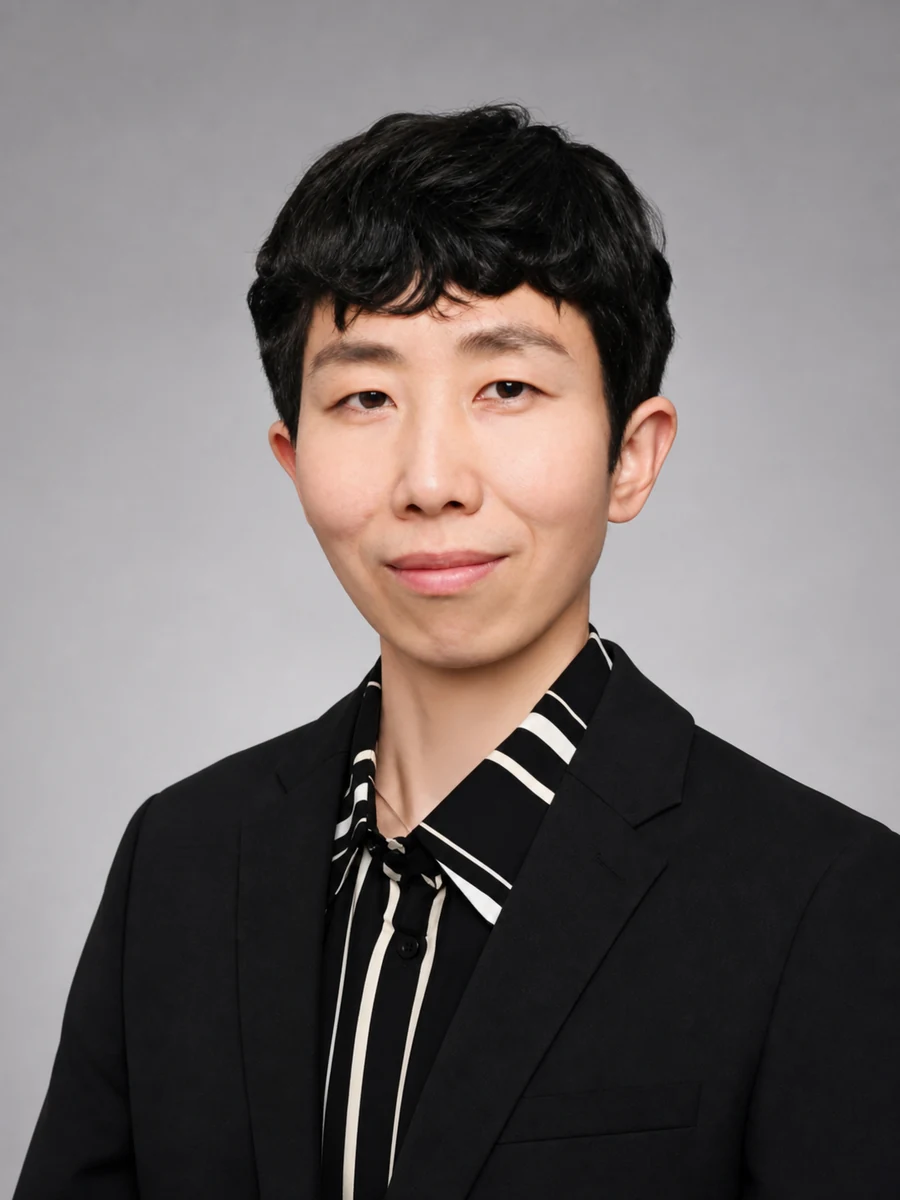
Xingnan Li, PhD works at the intersection of tumor biology, organoid technology and translational research. Her research spans early ALI intestinal culture, oncogenic transformation in primary tissue and the co-development of tumor-immune organoid methods.
As a co-first author of the 2018 Cell paper, she helped establish an approach for studying tumor cells with immune cells retained from the source sample within a three-dimensional tissue context. This body of work continues to guide model development, assay selection and study design at TRiCBIO.
Research focus
Xingnan Li, PhD focuses on tissue architecture, sample-derived immune cells and treatment response in ALI organoid systems, bringing this experience to TRiCBIO PDO 2.0 study design.
Research contributions
Research timeline
Contributed to early air–liquid interface methods for long-term epithelial culture and tissue architecture.
First-author work used primary mouse gastric, pancreatic and colonic organoids to study oncogenic transformation under defined genetic changes.
Published a first-author methods protocol for reproducible air–liquid interface organoid culture.
As co-first author, co-developed ALI patient-derived tumor organoids to study tumors with immune cells retained from the source sample.
Co-authored work on engineered matrices for human patient-derived intestinal organoids, broadening culture and translational applications.
Co-first author · Peer-reviewed publication · PMID 30550791
Selected paper figures
Figures from the 2018 Cell paper show ALI tumor-immune organoid establishment, tissue architecture and immune cells retained from the source sample—and how these elements inform PDO 2.0 study design.
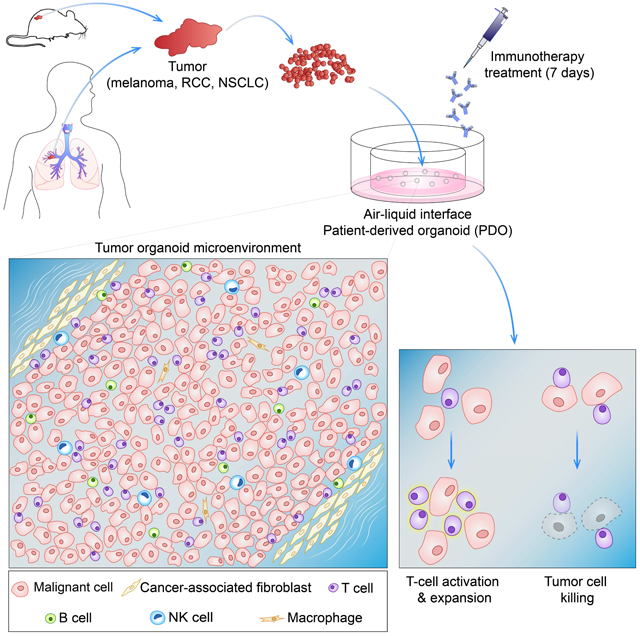
Summarizes how patient tumor tissue, ALI organoid culture, microenvironment context and immunotherapy studies connect.
Neal JT, Li X et al. Cell. 2018;175:1972–1988.e16. DOI 10.1016/j.cell.2018.11.021.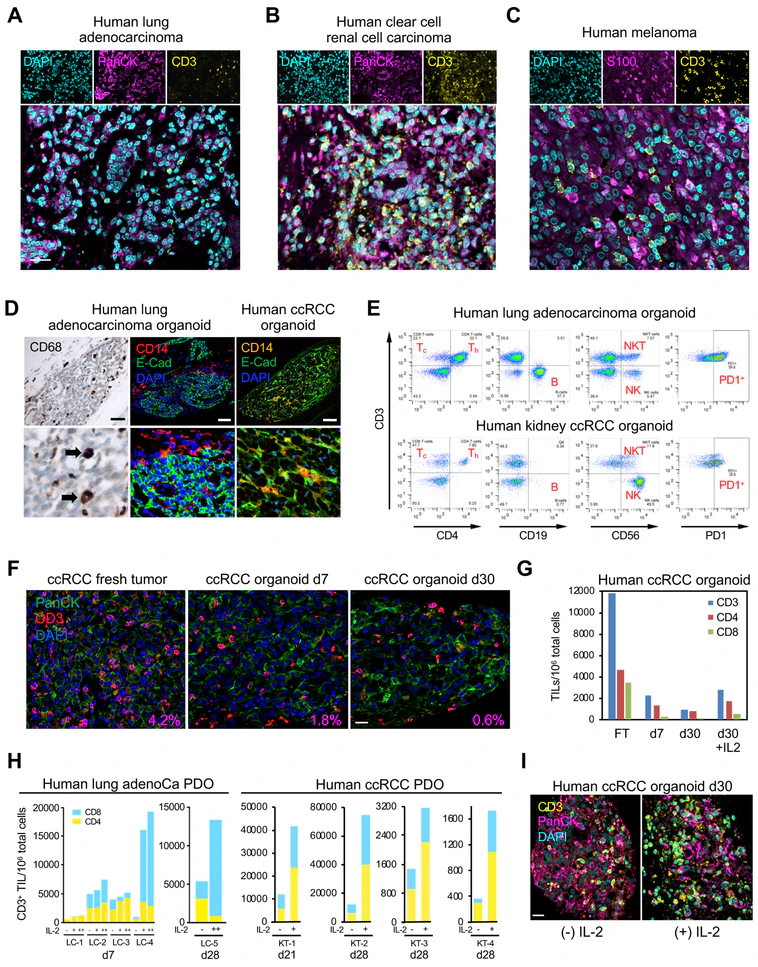
Shows tissue architecture and CD3, CD4, CD8, CD19, CD56 and PD-1 profiles across ALI organoids, including effects of culture duration and IL-2 on measurable TILs.
Neal JT, Li X et al. Cell. 2018;175:1972–1988.e16, Figure 3.Additional publications
Established long-term ALI culture of mouse small- and large-intestinal tissue with epithelial and stromal components, and examined Wnt- and Notch-related niche regulation.
PMID 19398967 · DOI 10.1038/nm.1951Used primary mouse gastric, pancreatic and colonic ALI organoids to model defined oncogenic transformation and validate cancer drivers.
PMID 24859528 · DOI 10.1038/nm.3585Published a practical protocol for ALI 3D culture of diverse primary gastrointestinal tissues to support reproducible method use.
PMID 27246020 · DOI 10.1007/978-1-4939-3603-8_4Examined engineered matrices that support human patient-derived intestinal organoid culture and expand understanding of organoid–matrix interactions.
PMID 34026461 · DOI 10.1002/advs.202004705Field recognition
Nature Reviews Cancer introduced the “Organoid 2.0” framing for ALI tumor–immune organoids in 2019 and revisited tumor–immune organoid models and applications in depth in 2024. For immunotherapy, complex drug mechanisms and tissue-level response studies, this direction adds biological context beyond epithelial-only organoids.
The article framed the Cell 2018 ALI tumor–immune organoid study as “Organoid 2.0”: extending the model beyond tumor epithelium to include source-sample tissue architecture and immune context for tumor–immune interaction studies.
DOI 10.1038/s41568-019-0108-x ↗2024 · Review ArticleThe review maps tumor–immune organoid models, immune-analysis approaches and drug-research applications, showing how tissue and immune context can inform the study of treatment response and mechanism.
DOI 10.1038/s41568-024-00706-6 ↗Xingnan Li’s peer-reviewed work spans ALI culture, oncogenic transformation in primary tissue, tumor–immune microenvironment models and engineered organoid culture, and continues to inform TRiCBIO’s PDO 2.0 model development and immune-study design.
PROJECT DISCUSSION
Tell us what you want to investigate. Our scientists will discuss suitable models, assays and next steps with you.
Scientific leadership
Xingnan Li, PhD works at the intersection of tumor biology, organoid technology and translational research. Her research spans early ALI intestinal culture, oncogenic transformation in primary tissue and the co-development of tumor-immune organoid methods.
As a co-first author of the 2018 Cell paper, she helped establish an approach for studying tumor cells with immune cells retained from the source sample within a three-dimensional tissue context. This body of work continues to guide model development, assay selection and study design at TRiCBIO.
Research focus
Xingnan Li, PhD focuses on tissue architecture, sample-derived immune cells and treatment response in ALI organoid systems, bringing this experience to TRiCBIO PDO 2.0 study design.
Research contributions
Research timeline
Contributed to early air–liquid interface methods for long-term epithelial culture and tissue architecture.
First-author work used primary mouse gastric, pancreatic and colonic organoids to study oncogenic transformation under defined genetic changes.
Published a first-author methods protocol for reproducible air–liquid interface organoid culture.
As co-first author, co-developed ALI patient-derived tumor organoids to study tumors with immune cells retained from the source sample.
Co-authored work on engineered matrices for human patient-derived intestinal organoids, broadening culture and translational applications.
Co-first author · Peer-reviewed publication · PMID 30550791
Selected paper figures
Figures from the 2018 Cell paper show ALI tumor-immune organoid establishment, tissue architecture and immune cells retained from the source sample—and how these elements inform PDO 2.0 study design.
Summarizes how patient tumor tissue, ALI organoid culture, microenvironment context and immunotherapy studies connect.
Neal JT, Li X et al. Cell. 2018;175:1972–1988.e16. DOI 10.1016/j.cell.2018.11.021.Shows tissue architecture and CD3, CD4, CD8, CD19, CD56 and PD-1 profiles across ALI organoids, including effects of culture duration and IL-2 on measurable TILs.
Neal JT, Li X et al. Cell. 2018;175:1972–1988.e16, Figure 3.Additional publications
Established long-term ALI culture of mouse small- and large-intestinal tissue with epithelial and stromal components, and examined Wnt- and Notch-related niche regulation.
PMID 19398967 · DOI 10.1038/nm.1951Used primary mouse gastric, pancreatic and colonic ALI organoids to model defined oncogenic transformation and validate cancer drivers.
PMID 24859528 · DOI 10.1038/nm.3585Published a practical protocol for ALI 3D culture of diverse primary gastrointestinal tissues to support reproducible method use.
PMID 27246020 · DOI 10.1007/978-1-4939-3603-8_4Examined engineered matrices that support human patient-derived intestinal organoid culture and expand understanding of organoid–matrix interactions.
PMID 34026461 · DOI 10.1002/advs.202004705Field recognition
Nature Reviews Cancer introduced the “Organoid 2.0” framing for ALI tumor–immune organoids in 2019 and revisited tumor–immune organoid models and applications in depth in 2024. For immunotherapy, complex drug mechanisms and tissue-level response studies, this direction adds biological context beyond epithelial-only organoids.
The article framed the Cell 2018 ALI tumor–immune organoid study as “Organoid 2.0”: extending the model beyond tumor epithelium to include source-sample tissue architecture and immune context for tumor–immune interaction studies.
DOI 10.1038/s41568-019-0108-x ↗2024 · Review ArticleThe review maps tumor–immune organoid models, immune-analysis approaches and drug-research applications, showing how tissue and immune context can inform the study of treatment response and mechanism.
DOI 10.1038/s41568-024-00706-6 ↗Xingnan Li’s peer-reviewed work spans ALI culture, oncogenic transformation in primary tissue, tumor–immune microenvironment models and engineered organoid culture, and continues to inform TRiCBIO’s PDO 2.0 model development and immune-study design.
PROJECT DISCUSSION
Tell us what you want to investigate. Our scientists will discuss suitable models, assays and next steps with you.